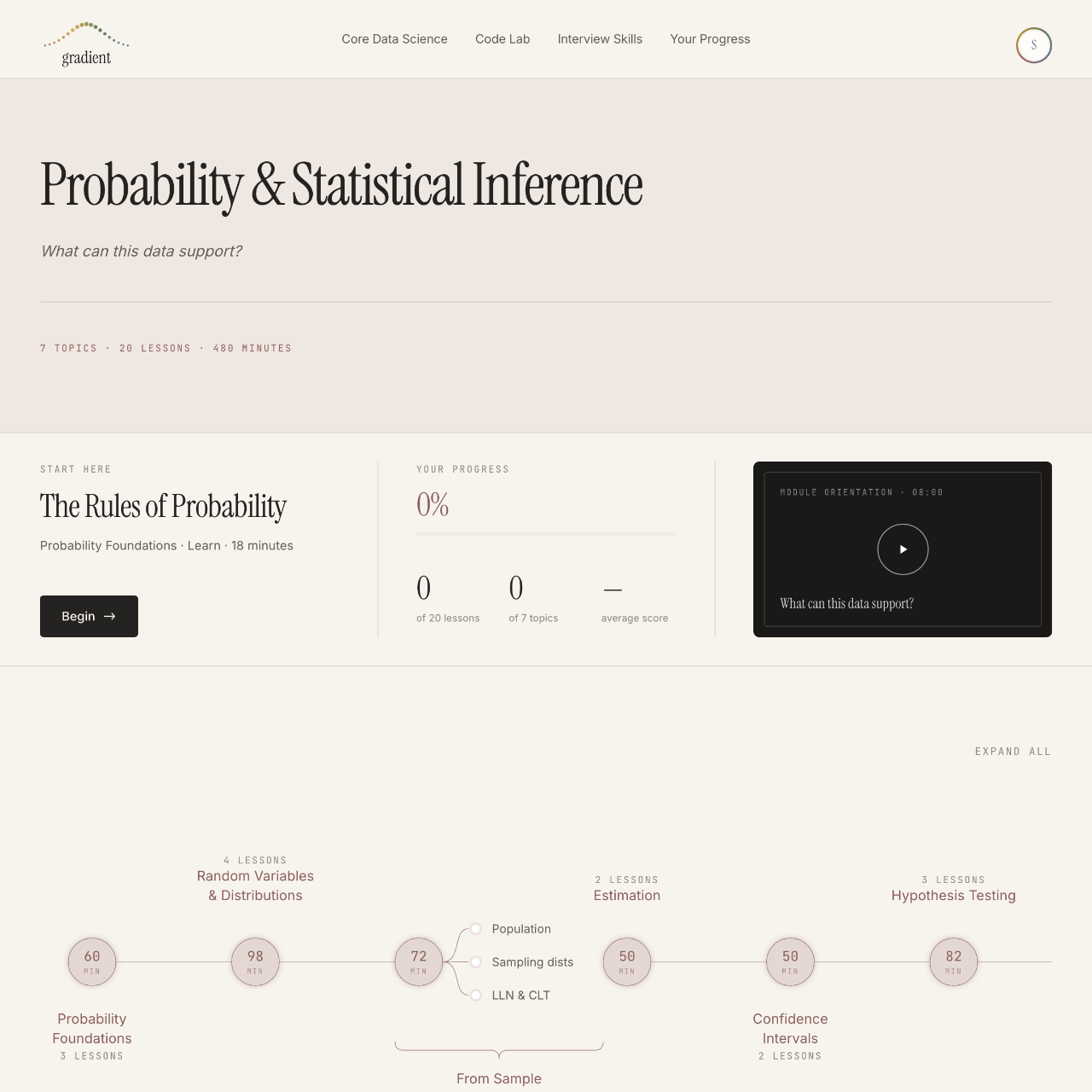
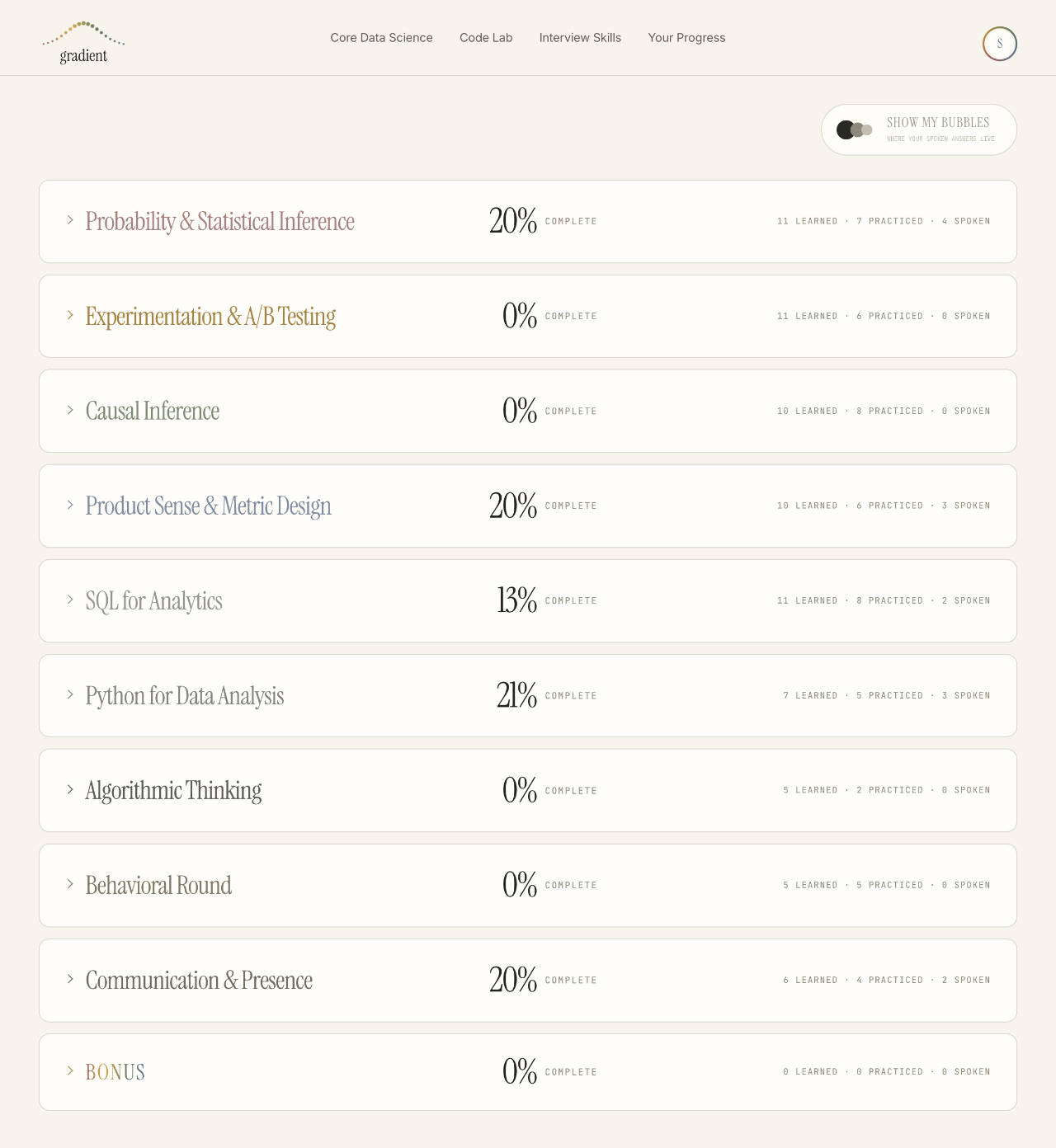
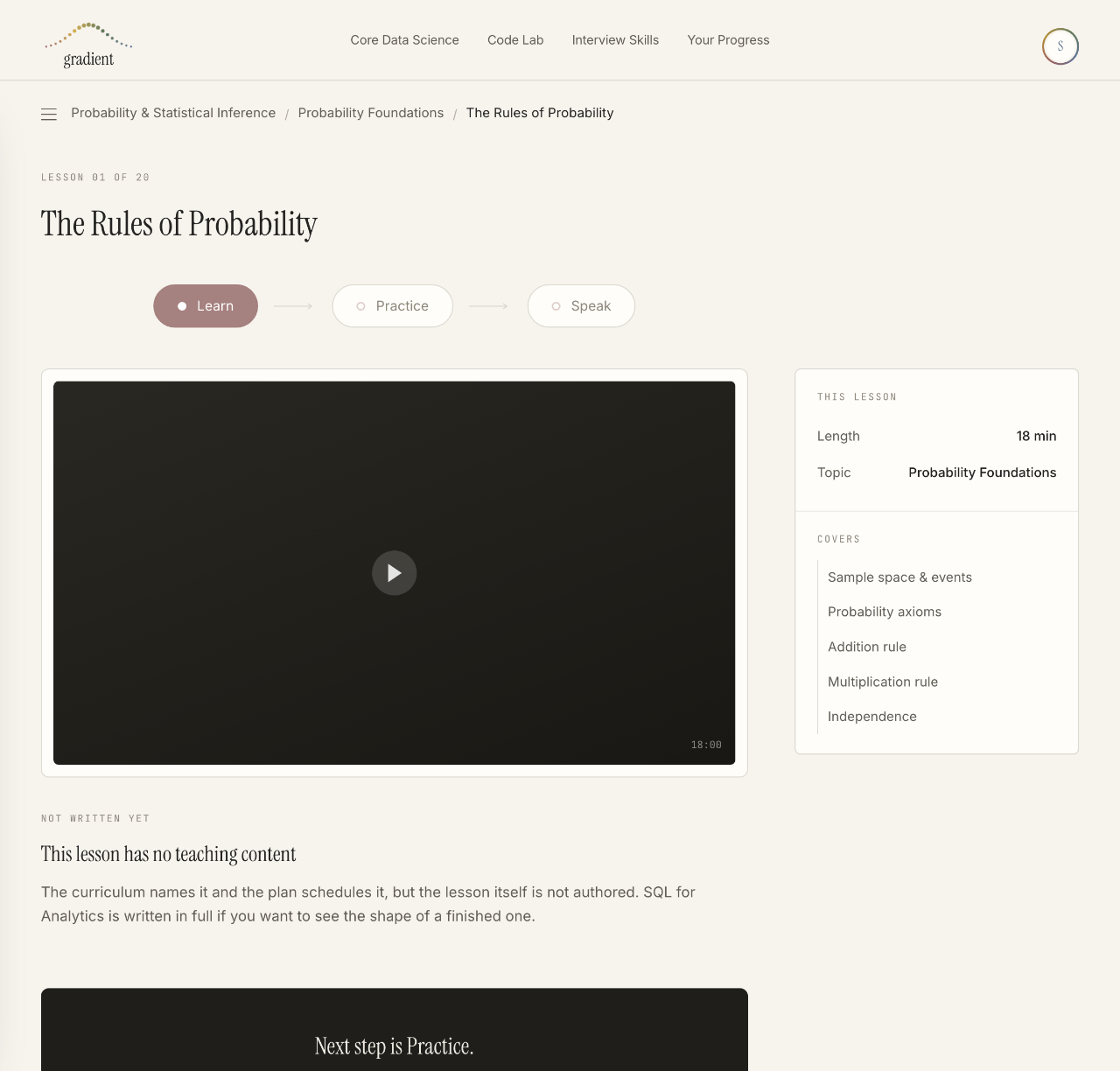
- 01Probability Foundations3 lessons · 60 min
- 02Random Variables & Distributions4 lessons · 98 min
- 03From Sample to Population3 lessons · 72 min
- 04Estimation2 lessons · 50 min
- 05Confidence Intervals2 lessons · 50 min
- 06Hypothesis Testing3 lessons · 82 min
- 07When Assumptions Break3 lessons · 68 min
Speaking-first data science interview prepKnow the answer.
Know the answer.
Make it land.
Gradient trains the technical judgment interviews demand, along with the structure, clarity, and concision that make that judgment visible.
Core Data ScienceFour modules.
Four modules.
The judgment behind data science interviews.
Build technical depth, practice the distinctions interviewers probe, and speak through the decisions a senior data scientist must defend.
Code LabPractice the code.
Practice the code.
Build the fluency.
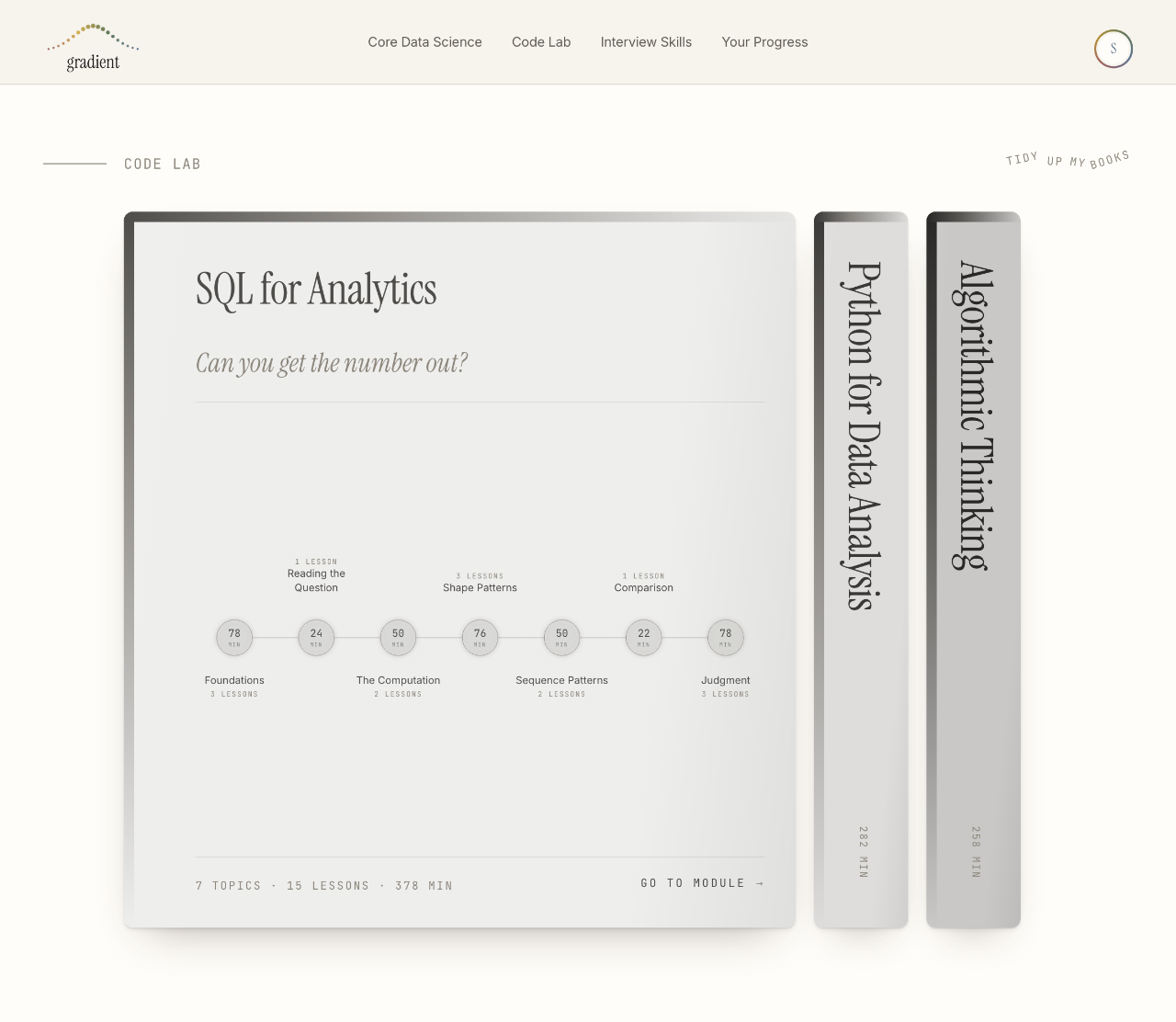
Code Lab measures correctness, efficiency, and live coding rhythm directly. Each area includes teaching, focused practice, and reference solutions.
RunShow hint
SQL for
Analytics
Joins, windows, cohorts, funnels, retention, and experiment tables.
47 verified questions
Python for
Data Analysis
Data manipulation, aggregation, cleaning, and practical analysis patterns.
36 focused problems
Algorithmic
Thinking
Arrays, hash maps, stacks, queues, trees, and complexity reasoning.
24 focused problems
Interview SkillsThe interview lessons
The interview lessons
experience teaches.
An original framework for making your knowledge available under pressure, from structuring the first sentence to recovering after a difficult moment.
Adversity
Expectation
Initiative
The learning loopBuild the reasoning.
Build the reasoning.
Then build the answer.
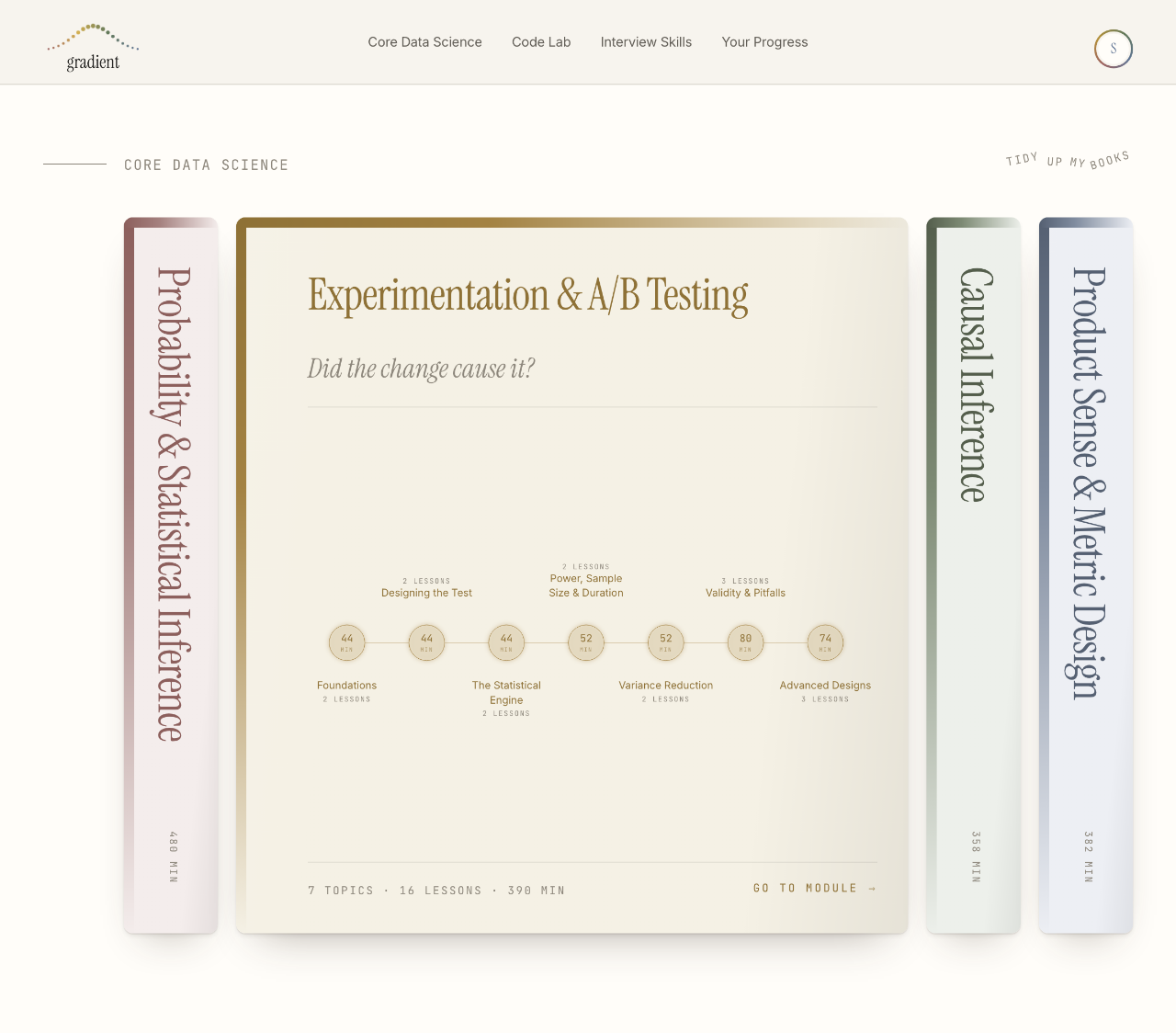
Probability & Statistical InferenceExperimentation & A/B TestingCausal InferenceProduct Sense & Metric DesignSQL for Analytics
LearnBuild the concept, the assumptions, and the intuition beneath the formula
PracticeRetrieve it, apply it, and tell it from the ideas nearby
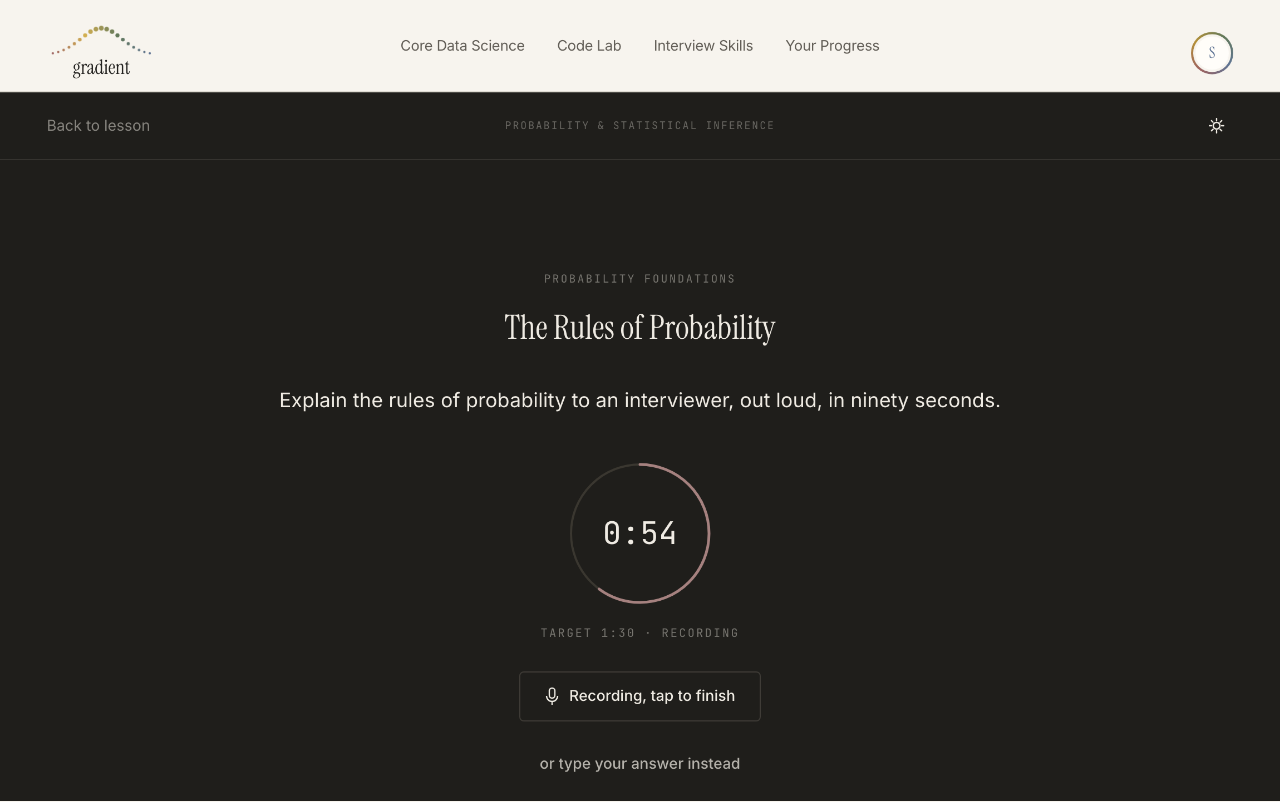
SpeakAnswer an interview question inside a real time window
FeedbackOne change to carry into the next attempt
“Lead with the assumption”68→74
“Name the guardrail first”71→79
“Say the counterfactual sooner”64→73
“That one held. Nothing to fix”80→84
“Check the grain before you join”66→77
Every core topic moves through the same deliberate sequence. Feedback returns you to the change that matters most for your next attempt.
How We MeasureKnowing it and saying it are different skills.
Knowing it and saying it are different skills.
We score both.
Why knowledge is only half the story
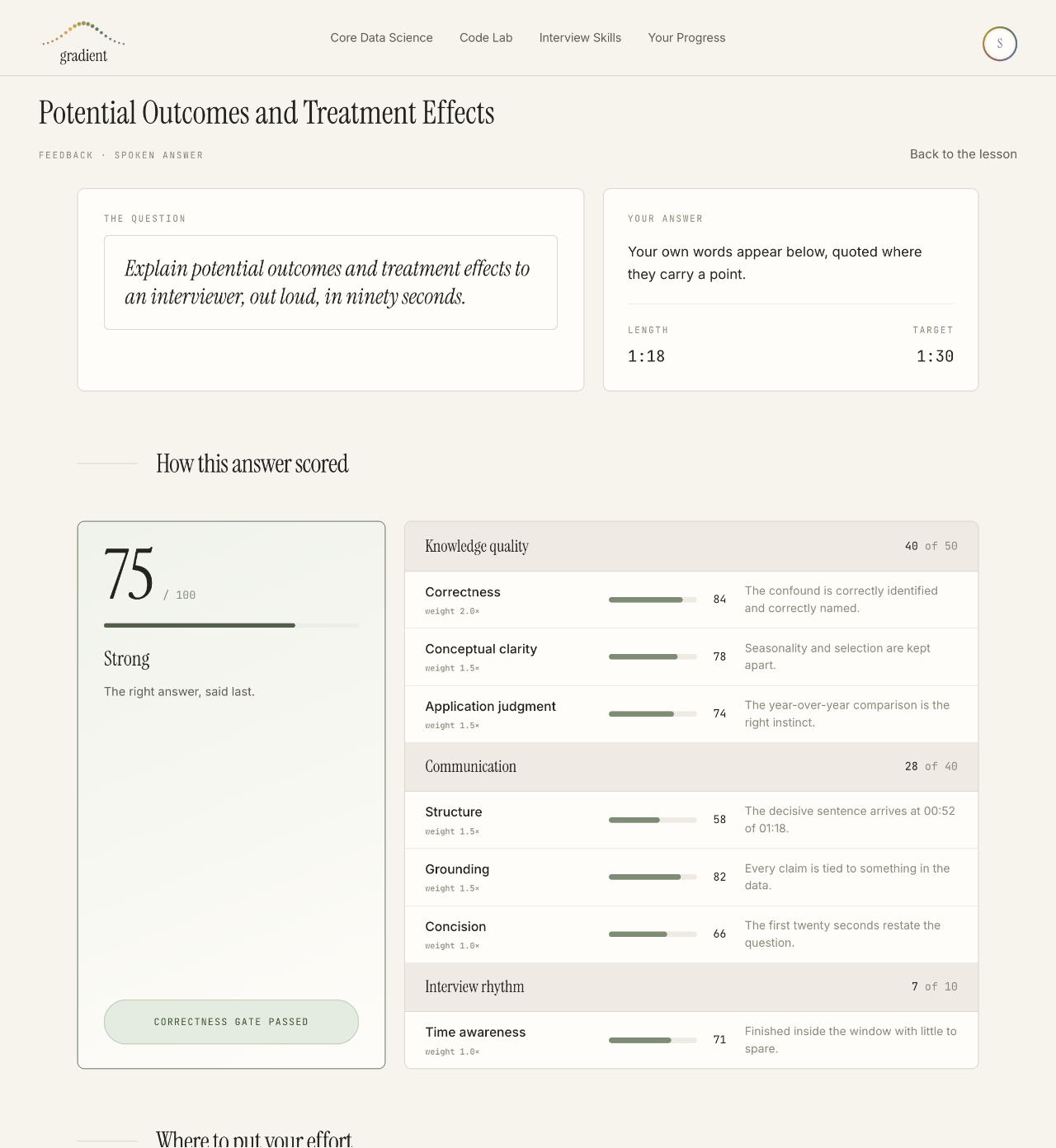
Knowing the answer creates potential. What reaches the interviewer is bounded by how you structure it, whether you ground it, and how much of their attention you spend getting there.
Concision is not brevity for its own sake. It is respect for the listener.
Correctness gate
If Correctness ≤ 40
  the overall score is capped at 60
Technical accuracy remains the threshold for interview readiness.
One answer is one data point
Every score belongs to one response, on one day, under one set of conditions. Your next attempt can be different.
Adaptive weighting
The same seven dimensions.
Weighted for the question: every profile keeps the same point budget: 50 knowledge, 40 communication, 10 rhythm. The emphasis moves inside each pillar so each question is judged by the work it actually asks you to do.
Question profile
“What is the Central Limit Theorem?”
Explain an idea so the intuition lands clearly.
Question profile
“How do you compute the standard error of a median?”
Show how something is done through correct inputs and ordered steps.
Question profile
“A t-test or a bootstrap here, and why?”
Choose between defensible options and say what decides it.
Question profile
“Daily actives dropped eight percent. Investigate.”
Work from a symptom to a cause without guessing first.
Question profile
“What metric would you use for Maps?”
Build something that does not exist yet and defend the shape of it.
Case studies
A case study composes several question profiles.
Long form cases move through multiple question forms. Each stage receives the profile matching the decision in front of you.
The scaleFive bands.
Five bands.
One continuous score.
The label describes one answer.
Your identity and potential stay outside the score.
Over time
Mastery is a weighted memory.
Recent work matters more, while every single session moves the record gradually.
A topic becomes mastered at 80+ on two separate sessions. One strong response shows possibility. Repetition turns it into evidence.
Mastery=0.3× this session+0.7× mastery so far
Example four previous sessions · sums to 100%
The latest session always owns 30%. The remaining 70% is distributed across the previous sessions using recency weights of 1, 0.7, 0.7², and so on, normalised to however many sessions actually exist. With only two previous sessions the same rule becomes 30.0% current, 41.2% one before, 28.8% two before.
FeedbackOne focused correction.
One focused correction.
Chosen from seven dimensions.
Gradient identifies the change most likely to improve your next response.
- One primary fix
The highest leverage change, quoting your own words.
- One observation
A secondary pattern worth noticing.
- One genuine strength
Specific evidence of what to repeat deliberately.
Causal Inference
Make the counterfactual your first sentence.
“We do not know what would have happened without launching it.”said at 00:52 of 01:18
Mastery across four attempts
Experimentation & A/B Testing
Name the guardrail before the lift.
“A one percent lift, if retention holds.”said at 00:31 of 01:24
Mastery across four attempts
Probability & Statistical Inference
That one held. Nothing to change.
“The assumption is independence, and it is the one that breaks.”said at 00:14 of 01:06
Mastery across four attempts
Product Sense & Metric Design
Say what the metric would miss.
“Engagement went up, so the change worked.”said at 00:22 of 01:11
Mastery across four attempts
SQL for Analytics
Check the grain before you join.
“One row here is one order, I think.”said at 00:08 of 00:58
Mastery across four attempts
gradientOpening soonFour core modules.
Four core modules.
The first one lands in November.
Three Code Lab paths, the Interview Skills framework, and one transparent scoring system. Leave your email and I will write when SQL for Analytics is ready.
One email when the first module opens, and occasionally a question with a worked solution. Nothing else, and unsubscribe in one click.